
In industrial level measurement applications, reliability is essential for process safety, inventory control and automation efficiency. Tanks and silos often contain liquids, solid particulate materials or aggressive media under challenging conditions such as dust, noise, condensation, foam, viscosity and temperature variation.
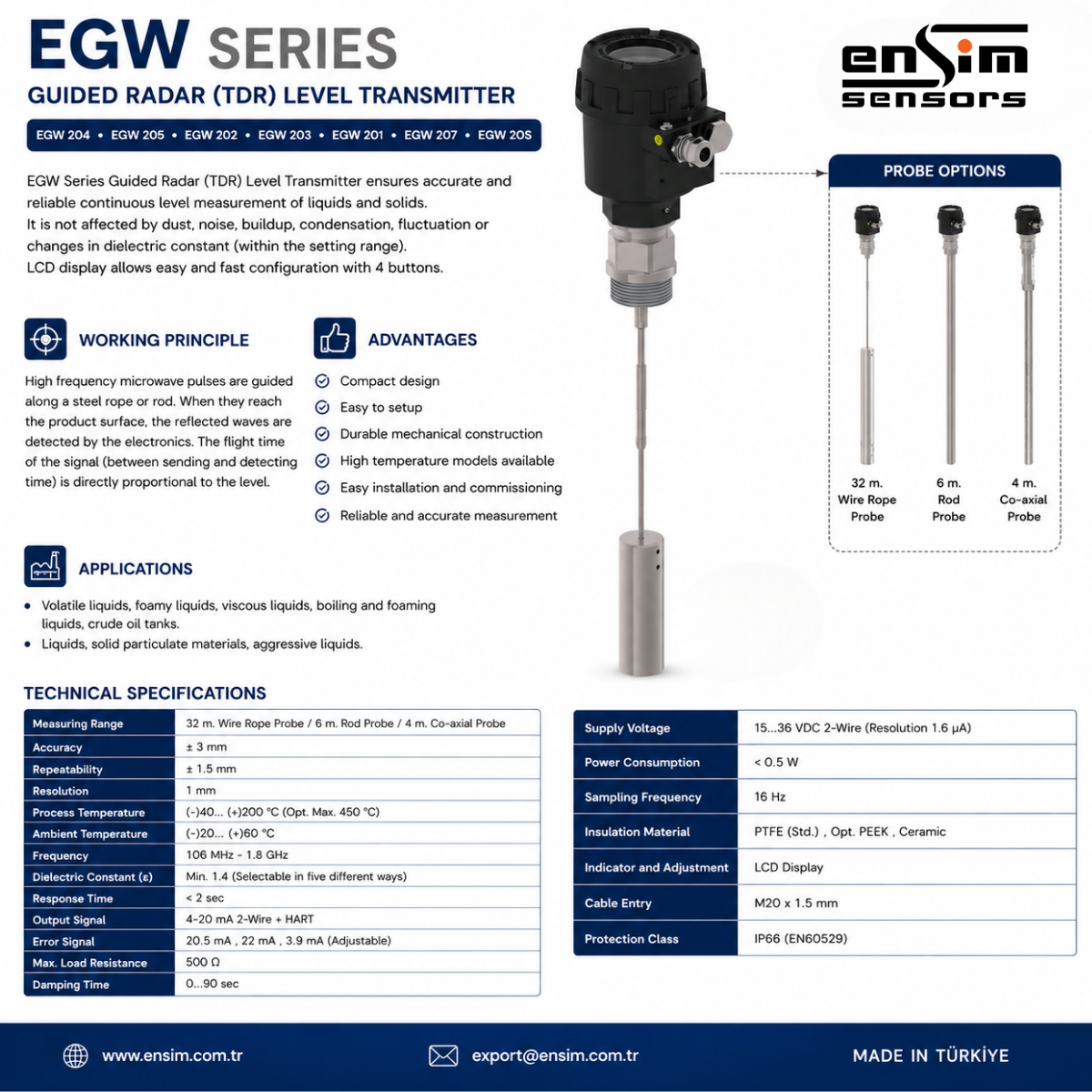
The EGW Guided Radar Level Transmitter is designed to provide continuous and accurate level measurement in these demanding applications. Using TDR guided radar technology, EGW offers stable performance for liquids and solids without being affected by many process conditions that can limit conventional level measurement methods.
What Is EGW?
EGW is a guided radar level transmitter used for continuous level measurement of liquids and solid materials. The product family includes models such as EGW 201, EGW 202, EGW 203, EGW 204, EGW 205, EGW 207 and EGW 20S.
Different probe types are available depending on the application. The series includes wire rope probes, rod probes and coaxial probes, allowing the transmitter to be selected according to tank height, material type and process requirements.
Working Principle
EGW works with Time Domain Reflectometry, also known as TDR. High-frequency microwave pulses are guided along a stainless steel rope or rod probe.
When the signal reaches the surface of the product, part of the microwave pulse is reflected back to the electronics. The transmitter calculates the time between sending and receiving the reflected signal. This flight time is directly proportional to the level inside the tank or silo.
Because the signal is guided along the probe, the measurement remains stable even in difficult process environments.
Stable Measurement in Difficult Conditions
One of the key advantages of EGW is its ability to provide reliable measurement in challenging applications. The catalog states that measurement is not affected by accumulation, condensation, dust, noise, medium density, fluctuation or dielectric constant variation within the setting range.
This makes EGW suitable for applications where non-contact measurement may be affected by internal structures, foam, turbulence or difficult surface conditions.
Application Areas
EGW can be used for liquids, solid particulate materials and aggressive liquids. Typical applications include volatile liquids, foamy liquids, viscous liquids, boiling and foaming liquids and crude oil tanks.
Because of its guided radar principle, EGW is also suitable for industrial tanks and silos where reliable continuous level measurement is required under demanding operating conditions.
Technical Specifications
The EGW series offers different measurement ranges depending on probe type. Wire rope probe versions can measure up to 32 m, rod probe versions up to 6 m, and coaxial probe versions up to 4 m.
The sensitivity is ±3 mm, repeatability is ±1.5 mm, and resolution is 1 mm. The response time is less than 2 seconds, and the sampling frequency is 16 Hz.
The operating pressure range is -1 bar to +40 bar, with optional versions available up to 100 bar. The standard working temperature range is -40 °C to +200 °C, with optional high-temperature versions up to 450 °C.
Output and Communication
EGW operates with a 15–36 VDC two-wire supply. The standard output signal is 4–20 mA two-wire + HART, with adjustable error signals of 20.5 mA, 22 mA or 3.9 mA.
The maximum load resistance is 500 Ω, and the damping time can be adjusted from 0 to 90 seconds. These features make EGW easy to integrate into PLC systems, process control systems, indicators and remote monitoring systems.
Display and Local Configuration
EGW includes an LCD display and can be configured locally with four buttons. The button functions include escape, backward, forward and enter.
This local interface allows technicians to adjust parameters directly at the installation point without requiring complex external tools. The settings menu language is English.
Robust Mechanical Design
EGW is designed with a durable mechanical structure. The housing material is aluminum injection AlSi2Fe, black RAL 9005. The standard connection and probe material is 304 stainless steel, with 316 stainless steel available as an option.
The standard insulation material is PTFE, while PEEK and ceramic insulation options are also available for more demanding temperature or chemical conditions.
The protection class is IP66 according to EN60529, supporting field installation in industrial environments.
Probe Options
EGW offers multiple probe configurations for different measurement needs.
EGW 204 is available with a rope probe and can measure up to 32 m. EGW 205 uses an uninsulated rod probe and can measure up to 6 m. EGW 202 and EGW 203 are coaxial probe models, with maximum ranges up to 2 m and 4 m depending on configuration.
EGW 201 offers a rod probe option up to 6 m, while EGW 207 provides an insulated rope probe up to 32 m. EGW 20S is designed as a high-temperature type with a coaxial probe structure.
High-Temperature Applications
For high-temperature processes, EGW can be configured with suitable insulation and accessories. PTFE insulation supports operation up to 200 °C, PEEK insulation supports up to 230 °C, and ceramic insulation supports up to 450 °C.
The catalog also lists a cooling apparatus made from 304 stainless steel. It can be applied to all models except EGW 20S and is suitable for process temperatures up to 250 °C.
Mechanical Connection Flexibility
EGW is available with different mechanical connection options. Threaded connections include 1 1/2" BSP and 2" BSP. Clamp, dairy, ISO flange and ANSI flange options are also available.
Flange options include DN50, DN80 and DN100 in PN16 and PN40 versions, as well as ANSI 150 lb connections. This wide mechanical connection range allows EGW to be used in many different tank and vessel designs.
Accessories
EGW can be supplied with useful accessories for special applications. The by-pass tube is made from 304 stainless steel and is manufactured by welding. It can be used in applications where a guided external measuring chamber is required.
A protection sleeve for the external side of the tank is also available. It is made from 304 stainless steel, welded, hinged and openable, and is designed to protect the transmitter against external environmental conditions.
The optional cooling apparatus supports use in higher process temperature applications.
Installation Considerations
Correct installation is important for guided radar measurement. The catalog defines important distances such as minimum dead zone, maximum dead zone, maximum level distance, minimum level distance and reference plane.
For reliable operation, distance from walls and internal structures should be considered. For example, flat metal walls, plastic walls and concrete walls require different minimum clearances. For long probes above 3 m, support may be required depending on application conditions.
Why Choose EGW?
EGW is a strong choice for continuous level measurement where accuracy, stability and mechanical durability are required. Its guided radar technology provides reliable performance in dust, condensation, foam, turbulence and changing dielectric conditions.
The transmitter also offers easy setup, compact structure, HART communication, local LCD configuration, multiple probe types and high-temperature model options.
For industrial users handling liquids, solids or aggressive media, EGW provides a flexible and robust TDR level measurement solution.
Conclusion
The EGW Guided Radar Level Transmitter is a reliable solution for continuous level measurement in liquids, solid particulate materials and aggressive liquids. With TDR guided radar technology, multiple probe options, 4–20 mA + HART output, IP66 protection, stainless steel probe construction and high-temperature configurations up to 450 °C, EGW is well suited for demanding industrial tank and silo applications.
From volatile and foamy liquids to viscous media, boiling products, crude oil tanks and bulk solids, EGW helps operators achieve accurate, stable and dependable level measurement in challenging process environments.