
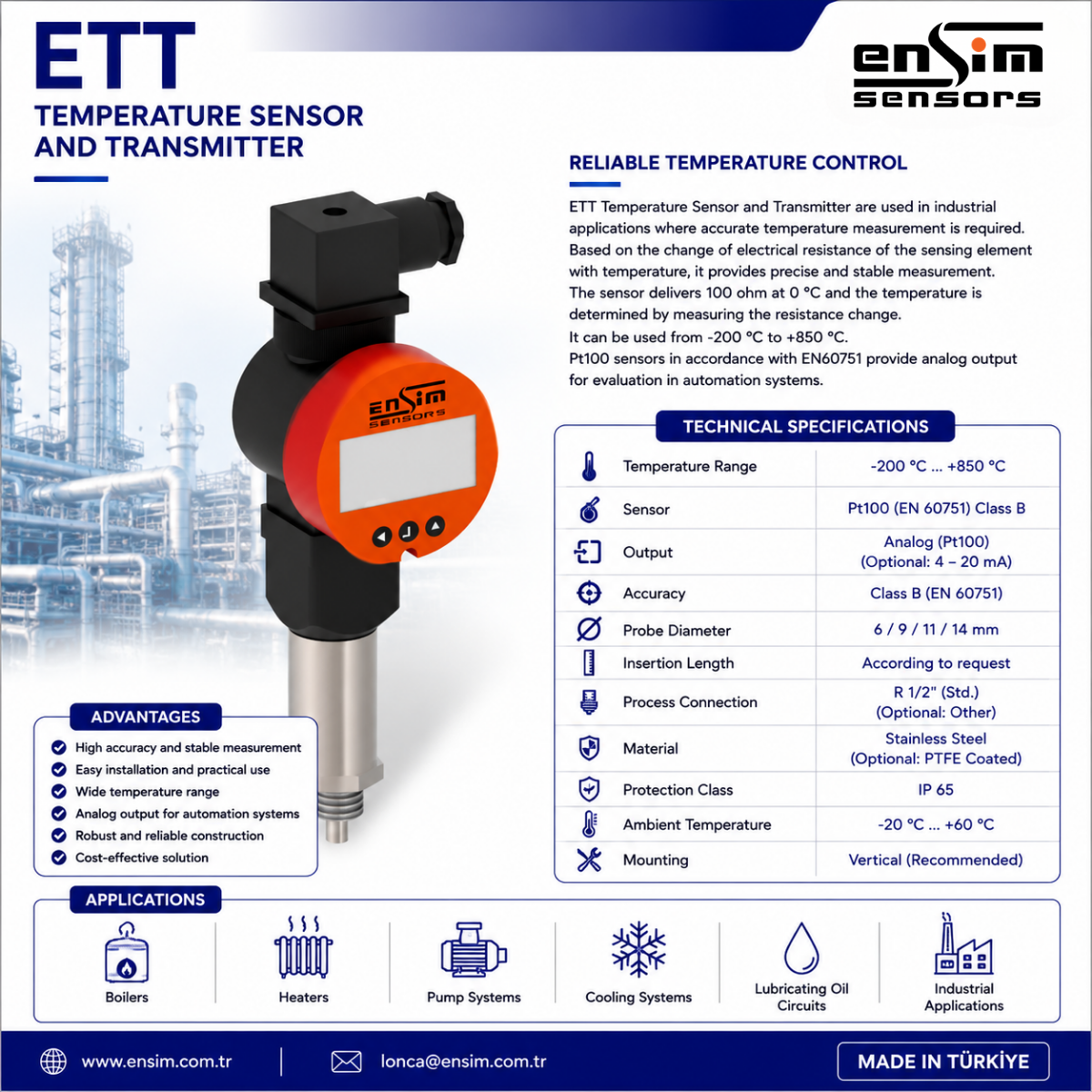
Accurate temperature measurement is one of the most important requirements in industrial automation and process control. Machines, tanks, boilers, gas lines, liquid processes, surface measurement points and ambient monitoring applications all require reliable temperature data for safe and efficient operation.
The ETT Temperature Sensor and Transmitter Series is designed for these requirements. Based on Pt100 resistance thermometer technology, the ETT series provides practical, economical and configurable solutions for industrial temperature measurement applications.
What Is the ETT Series?
The ETT series is a family of temperature sensors and transmitters used for precise temperature measurement in industrial applications.
The product range includes many model options such as ETT 01, ETT 02, ETT 03, ETT 04, ETT 05, ETT 06, ETT 06p, ETT 07, ETT 08, ETT 09, ETT 09p, ETT 10, ETT 10p, ETT 11, ETT 12, ETT 13, ETT 11m, ETT 12m, ETT 21, ETT 21p, ETT 22, ETT 23 and ETT 31.
This wide model range allows users to select the correct mechanical connection, immersion length, output type, housing, material and protection class according to the application.
Pt100 Resistance Thermometer Principle
Resistance thermometers operate based on the change of electrical resistance according to temperature. In the ETT series, the sensing element is typically a Pt100 resistance detector.
A Pt100 sensor gives 100 ohm resistance at 0 °C. As temperature changes, the resistance value changes. By measuring this resistance variation, the system determines the temperature.
The catalog explains that resistance detectors can use thin platinum or nickel wire insulated inside enamel, glass or ceramic. Pt100 sensors according to EN60751 can provide analog information that is evaluated in automation systems.
Why Pt100 Sensors Are Preferred
Pt100 resistance thermometers are widely preferred in industrial applications because they provide stable and accurate temperature measurement.
They are suitable for a broad temperature range and can be used from -200 °C to +850 °C depending on construction and application conditions.
This makes the ETT series suitable for demanding industrial processes where accurate and repeatable temperature measurement is required.
Application Areas
The ETT series can be used in many industrial measurement points.
Typical application areas include machines, tanks, boilers, gas and liquid media, surface temperature measurement and ambient temperature measurement.
These applications are common in process plants, machinery manufacturing, heating systems, cooling systems, food production, energy systems, chemical processes and general industrial automation.
Installation Length Recommendation
Correct immersion length is important for accurate temperature measurement.
The catalog recommends that the immersion length should be approximately 6 to 15 times the immersion diameter for resistance thermometers to measure correctly.
This means the sensor must be inserted deeply enough into the process to sense the actual process temperature instead of being affected by external heat transfer or connection temperature.
Cable and Wiring Recommendations
The catalog also gives guidance for Pt100 wiring.
Between the Pt100 element and the terminal, copper or silver wire can be used up to 500 °C. Above 550 °C, nickel-chromium wire should be used.
Between the device and the Pt100 sensor, copper conductor cable is used. Up to 10 m, a 2-wire connection may be used. Up to 150 m, a 3-wire connection should be used. Above 150 m, a 4-wire connection is recommended.
This wiring guidance is important for reducing measurement errors caused by cable resistance.
General Advantages
The ETT series offers several practical advantages.
The catalog highlights model options up to 600 bar, practical and economical mounting, and the possibility of mounting a digital display.
These advantages make ETT suitable for both standard temperature measurement points and more demanding process applications.
ETT 01, ETT 02, ETT 03 and ETT 04 Models
ETT 01, ETT 02, ETT 03 and ETT 04 are immersion-type Pt100 sensors with terminal connection.
These models use 1 x Pt100, 3-wire, Class B according to EN60751. The material is stainless steel, and the protection class is IP65.
ETT 01 has no standard mechanical connection, while ETT 02 and ETT 03 use R 1/2" standard connection. ETT 04 uses 2" PN16 flanged connection.
The measurement range is -50 °C to +650 °C, and ambient temperature is -20 °C to +60 °C.
Available immersion diameters include 6, 9, 11 and 14 mm depending on model.
ETT 05 Insert Type
ETT 05 is an insert-type temperature sensor.
It has a measurement range of -50 °C to +650 °C and uses R 1/2" standard mechanical connection.
The electrical connection is terminal type, and the sensor is 1 x Pt100, 3-wire, Class B according to EN60751.
The material is stainless steel, and the immersion diameter is 6 mm.
ETT 07 Clamp Type
ETT 07 is an immersion-type model with 1" clamp standard connection.
It is designed for applications requiring clamp-type installation, often preferred where sanitary or quick-removal installation is useful.
The measurement range is -50 °C to +800 °C. The sensor is 1 x Pt100, 3-wire, Class B, with stainless steel material and IP65 protection.
ETT 06 and ETT 06p Models
ETT 06 and ETT 06p are immersion-type temperature sensors with R 1/2" standard mechanical connection and PG9 metal electrical connection.
Their measurement range is -30 °C to +200 °C.
The sensor is 1 x Pt100, 3-wire, Class B according to EN60751. The material is stainless steel, with PTFE available as an option.
The protection class is IP68, and available immersion diameters are 6 mm and 9 mm.
ETT 08 Cable Type
ETT 08 is an immersion-type sensor with cable connection.
It has a measurement range of -30 °C to +200 °C and uses M10 x 1.5 mm mechanical connection.
The sensor is 1 x Pt100, 3-wire, Class B, with stainless steel material and IP68 protection.
The immersion diameter is 6 mm, and the immersion length can be selected according to application needs.
ETT 09, ETT 09p, ETT 10 and ETT 10p Models
ETT 09 and ETT 09p are immersion-type sensors with R 1/2" standard connection and DIN 43650C electrical connection.
Their measurement range is -30 °C to +100 °C, and they use 1 x Pt100, 3-wire, Class B.
ETT 10 and ETT 10p are similar models but have a wider measurement range of -30 °C to +200 °C. They use DIN 43650 / ISO 4400 electrical connection.
The material is stainless steel, with optional PTFE, and protection class is IP65.
ETT 11, ETT 12 and ETT 13 Wall Type Models
ETT 11, ETT 12 and ETT 13 are wall-type temperature sensors.
Their measurement range is -40 °C to +80 °C, with 0–80 °C perforated type option.
They use DIN 43650C electrical material, 1 x Pt100, 3-wire, Class B sensor structure and stainless steel material.
Output options include 1 x Pt100 or 4–20 mA two-wire. Supply voltage is 10–30 VDC. Protection class is IP68, immersion diameter is 6 mm, and standard immersion length is 50 mm.
ETT 11m and ETT 12m Models
ETT 11m and ETT 12m are wall-type models for ambient or duct-type temperature applications.
They provide 1 x Pt100 or 4–20 mA two-wire output with 10–30 VDC supply.
ETT 11m uses cable electrical connection and has IP68 protection. ETT 12m uses DIN 43650C electrical connection and has IP65 protection.
Both models have 6 mm immersion diameter and 50 mm standard immersion length.
ETT 21 and ETT 21p Transmitter Models
ETT 21 is an immersion-type temperature transmitter with R 1/2" standard mechanical connection.
It has a measurement range of -50 °C to +200 °C. ETT 21p has a measurement range of -50 °C to +150 °C and uses PTFE material.
These models support 2-wire 4–20 mA standard output. Other output options include 3-wire 4–20 mA, 0–20 mA, 0–5 V, 1–5 V and 0–10 V.
Supply voltage is 10–30 VDC, electrical connection is DIN 43650 / ISO 4400, and protection class is IP65.
ETT 22 and ETT 23 Compact Transmitters
ETT 22 and ETT 23 are compact immersion-type transmitter models with R 1/4" standard mechanical connection.
They have a measurement range of -50 °C to +200 °C and use DIN 43650A / ISO 4400 electrical connection.
They support 2-wire 4–20 mA standard output and optional 3-wire 4–20 mA, 0–20 mA, 0–5 V, 1–5 V and 0–10 V outputs.
ETT 23 has 15 mm immersion length, while ETT 22 has 20 mm / 25 mm immersion length. The immersion diameter is 8 mm.
ETT 31 Extended Immersion Transmitter
ETT 31 is an extended immersion temperature transmitter designed for higher temperature applications.
It has a measurement range of -50 °C to +650 °C and uses R 1/2" standard mechanical connection.
Output options include 2-wire 4–20 mA standard, 3-wire 4–20 mA, 0–20 mA, 0–5 V, 1–5 V and 0–10 V.
Supply voltage is 10–30 VDC, material is stainless steel, protection class is IP65, and immersion diameter is 8 mm. The immersion length is selected according to application requirements.
Mechanical Connection Options
The ETT series can be configured with multiple mechanical connection types.
Threaded options include R 1/8, R 1/4, R 3/8, R 1/2, R 3/4, R 1, R 1 1/4, R 1 1/2 and R 2.
Flanged options include PN16, PN40 and ANSI 150 LBS standards in different DN sizes. Clamp and dairy connection options are also available.
This wide mechanical connection range allows ETT sensors to be adapted to process tanks, pipelines, machinery and sanitary installations.
Thermowell Compatibility
The catalog includes thermowell options under ELX models, such as ELX 51 threaded type, ELX 52 straight type, ELX 53 flanged type, ELX 54 sanitary type and ELX 55 dairy type.
Thermowells are useful when the temperature sensor must be protected from process pressure, flow impact or corrosive media. They also allow sensor replacement without stopping the process.
This compatibility increases the safety and maintainability of ETT temperature measurement points.
RTD Cable Selection
The ETT catalog highlights the importance of RTD cable selection.
Resistance thermometers use copper cable between the sensor and the device. Cable cross-section is important. The catalog notes that 2 x 1.5 mm² copper cables with 0.2 ohm resistance are commonly preferred.
This is especially important in longer cable runs, where incorrect cable selection may introduce measurement error.
Electrical Connection
Different ETT models support different wiring structures.
For ETT 01, ETT 02, ETT 03, ETT 04, ETT 05 and ETT 07, the catalog shows Pt100 terminal wiring with red and white conductors.
For ETT 09, ETT 09p, ETT 10 and ETT 10p, socket-style Pt100 wiring is shown.
For ETT 11, ETT 12, ETT 13, ETT 21, ETT 21p, ETT 22, ETT 23 and ETT 31, both 2-wire and 3-wire transmitter wiring diagrams are shown.
The catalog also shows optional digital display wiring examples such as 4–20 mA two-wire + 2 PNP outputs.
Digital Display Options
The ETT series can be supplied with optional digital display accessories.
The ordering structure lists local digital display EDS 01 and dual-cell digital display EDS 02 as options.
This allows users to monitor temperature locally at the installation point and also transmit the signal to an automation system.
Ordering Flexibility
The ETT ordering code allows users to define model, certificate, housing, electrical connection, number of elements, output, measurement range, connection size, connection material, protective tube diameter, external protective tube material, immersion length and optional accessories.
Available outputs include 4–20 mA two-wire, 20 mA three-wire, 0–10 V three-wire, 0–20 V three-wire, Pt100 Class A and Pt100 Class B.
Available connection materials include 304 stainless steel, 316 stainless steel, brass, PVC, polypropylene, Delrin, PVDF, PBT and PTFE.
This configuration flexibility makes the ETT series suitable for both standard and special temperature measurement applications.
Why Choose the ETT Series?
The ETT series is a strong choice when industrial temperature measurement requires flexibility, reliability and multiple configuration options.
With Pt100 sensor technology, EN60751 compliance, stainless steel construction, different mechanical connections, optional transmitter outputs, IP65/IP68 models, thermowell compatibility and digital display options, ETT provides a complete temperature measurement solution.
From machinery and tanks to boilers, gases, liquids, surfaces and ambient monitoring, the ETT series can be adapted to many industrial applications.
Conclusion
The ETT Temperature Sensor and Transmitter Series provides reliable Pt100-based temperature measurement for industrial processes. With multiple models, wide temperature ranges, stainless steel construction, transmitter output options, configurable immersion lengths and mechanical connection alternatives, ETT offers a flexible solution for process and equipment temperature monitoring.
For applications requiring accurate temperature measurement in machines, tanks, boilers, gas and liquid media, surface points or ambient conditions, ETT sensors and transmitters deliver practical, economical and dependable performance.