
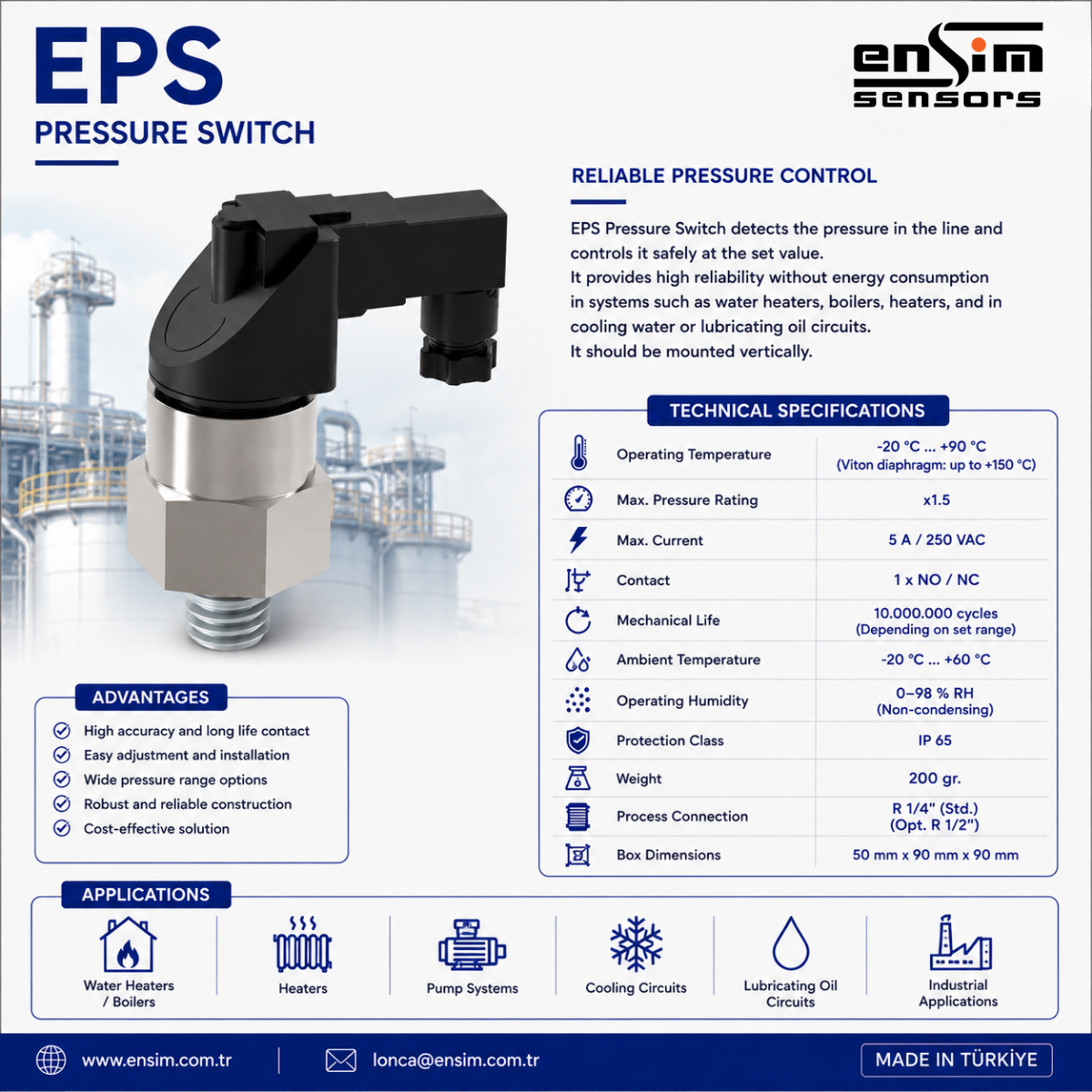
EPS Pressure Switch Series: Reliable and Economical Pressure Control for Industrial Applications
In industrial systems, pressure monitoring is essential for safe and stable operation. Heating devices, boilers, cooling water circuits, lubrication oil lines and machine systems require reliable pressure information to protect equipment and control process conditions.
The EPS Pressure Switch Series is designed to detect line pressure and provide a safe contact signal at the adjusted pressure value. With its compact structure, high sensitivity, easy adjustment and economical design, EPS offers a practical pressure control solution for many industrial and equipment applications.
What Is the EPS Pressure Switch Series?
The EPS series is a mechanical pressure switch family used to monitor pressure inside a line. When the pressure reaches the adjusted set point, the internal contact changes position and provides an electrical output signal.
This signal can be used for alarm, pump control, equipment protection, automation input or safety control functions.
The EPS series includes both metal type and plastic type models. This allows users to select the correct version according to pressure range, body material, process conditions and application requirement.
Application Areas
EPS pressure switches can be used in devices such as water heaters, combi boilers and heating systems.
They are also suitable for cooling water circuits and lubrication oil circuits, where pressure information must be obtained with high reliability and without energy consumption at the measuring point.
The catalog states that the product should ideally be mounted vertically. Correct installation helps ensure stable operation and reliable pressure switching.
Operating Principle
The EPS pressure switch operates with a spring and diaphragm mechanism.
Inside the body, a compressed spring is positioned against a diaphragm. When process pressure acts on the diaphragm, the diaphragm moves and triggers the contact placed inside the body.
The contact does not come into direct contact with the fluid. When the pressure drops back to the adjusted level, the contact returns to its original position.
This simple mechanical structure provides high sensitivity and long contact life.
Metal and Plastic Type Options
The EPS series is available in stainless steel and plastic body types.
The stainless steel type uses 316 stainless steel body material. The diaphragm material can be NBR, stainless steel or Viton. Plastic parts are made of polypropylene, and the O-ring is NBR.
The plastic type uses polypropylene body material. The diaphragm is NBR as standard, with Viton available as an option. Plastic parts are polypropylene, and the O-ring is NBR.
This model structure allows users to select the correct product according to chemical compatibility, temperature requirement, pressure range and budget.
Measurement Ranges
The EPS series includes multiple pressure ranges for both metal and plastic models.
For metal models, the available ranges include:
EPS 01s: 0.2–1 bar
EPS 05s: 0.5–5 bar
EPS 10s: 1–10 bar
EPS 20s: 2–20 bar
EPS 100s: 10–100 bar
EPS 200s: 50–200 bar
EPS 400s: 50–400 bar
For plastic models, the available ranges include:
EPS 00p: -0.8 to -0.1 bar
EPS 01p: 0.2–1 bar
EPS 05p: 0.5–5 bar
EPS 10p: 1–10 bar
EPS 20p: 2–20 bar
This wide range makes the EPS series suitable for low-pressure, vacuum and high-pressure monitoring applications.
Technical Specifications
The standard mechanical connection is R 1/4" for both stainless steel and plastic types.
Maximum pressure resistance is listed as x1.5. The maximum current is 5 A / 250 VAC, and the contact structure is 1 x NO/NC.
The working life is specified as 10,000,000 operations, depending on the measuring range.
The protection class is IP65, supporting use in industrial environments where protection against dust and water splash is required.
The box dimensions are 50 mm x 90 mm x 90 mm for both metal and plastic types.
Temperature and Environmental Conditions
For stainless steel models, the working temperature range is -20 °C to +90 °C as standard. With Viton diaphragm, the working temperature range can reach -20 °C to +150 °C.
For plastic models, the working temperature range is -20 °C to +60 °C.
The ambient temperature range is -20 °C to +60 °C. Working humidity is 0–98% RH, non-condensing.
The weight is approximately 200 g for stainless steel models and 100 g for plastic models.
Electrical Connection
The EPS series uses a socket electrical connection.
The terminal structure is shown as:
1: Normally Open
2: Normally Closed
3: Common
This simple electrical configuration makes EPS easy to integrate into control panels, alarm circuits, PLC inputs and machine control systems.
Set Point Adjustment
The set point can be adjusted by the user.
To adjust the set value, the cover above the adjustment thread is removed. A 3 mm Allen adjustment screw is then accessible.
When the Allen screw is turned clockwise, the set point increases. When it is turned counterclockwise, the set point decreases.
After the adjustment is completed, the cover should be installed again.
This adjustment method makes commissioning and field tuning simple for maintenance teams and installers.
Main Advantages
The EPS pressure switch series offers several practical advantages.
It provides high sensitivity, allowing precise pressure detection. It is also easy to adjust and install, reducing commissioning time.
Its economical design makes it suitable for OEM equipment, standard industrial applications and systems where simple pressure control is required.
The long contact life and mechanical operating principle support reliable use in many pressure monitoring points.
Ordering Flexibility
The EPS ordering structure allows selection of model type, certificate, output, alarm position, body material, diaphragm material, connection and optional features.
Output is listed as NO/NC relay, 5 A. Alarm position can be selected as increasing pressure or decreasing pressure.
Body material options include 304 stainless steel, 316 stainless steel and Delrin, with special versions available on request.
Diaphragm options include stainless steel diaphragm up to 10 bar, NBR diaphragm and Viton diaphragm.
Connection options include R 1/4" and R 1/2".
Why Choose the EPS Series?
The EPS series is a strong choice when a compact, reliable and economical pressure switch is required.
Its metal and plastic model options cover a wide pressure range from vacuum applications to high-pressure systems up to 400 bar model range. The adjustable set point, NO/NC contact output, IP65 protection and long contact life make it practical for both industrial machinery and equipment manufacturing.
For heating, cooling, lubrication and general pressure monitoring applications, EPS provides a simple and dependable pressure signal.
Conclusion
The EPS Pressure Switch Series provides reliable pressure control for industrial and equipment applications. With stainless steel and plastic body options, multiple pressure ranges, 1 x NO/NC contact, 5 A / 250 VAC rating, R 1/4" standard connection, IP65 protection and easy set point adjustment, EPS offers a practical solution for pressure monitoring.
From water heaters and combi boilers to cooling water and lubrication oil circuits, EPS pressure switches help protect equipment, improve process reliability and provide accurate pressure status information with a compact and economical design.