
In industrial silos and tanks, reliable level detection is essential for preventing overflow, avoiding empty-bin conditions and maintaining stable process operation. Bulk solids such as plastic granules, flour, cement, sand, coal, grain, powdered materials and chemical raw materials require robust level switches that can operate reliably under different density and flow conditions.
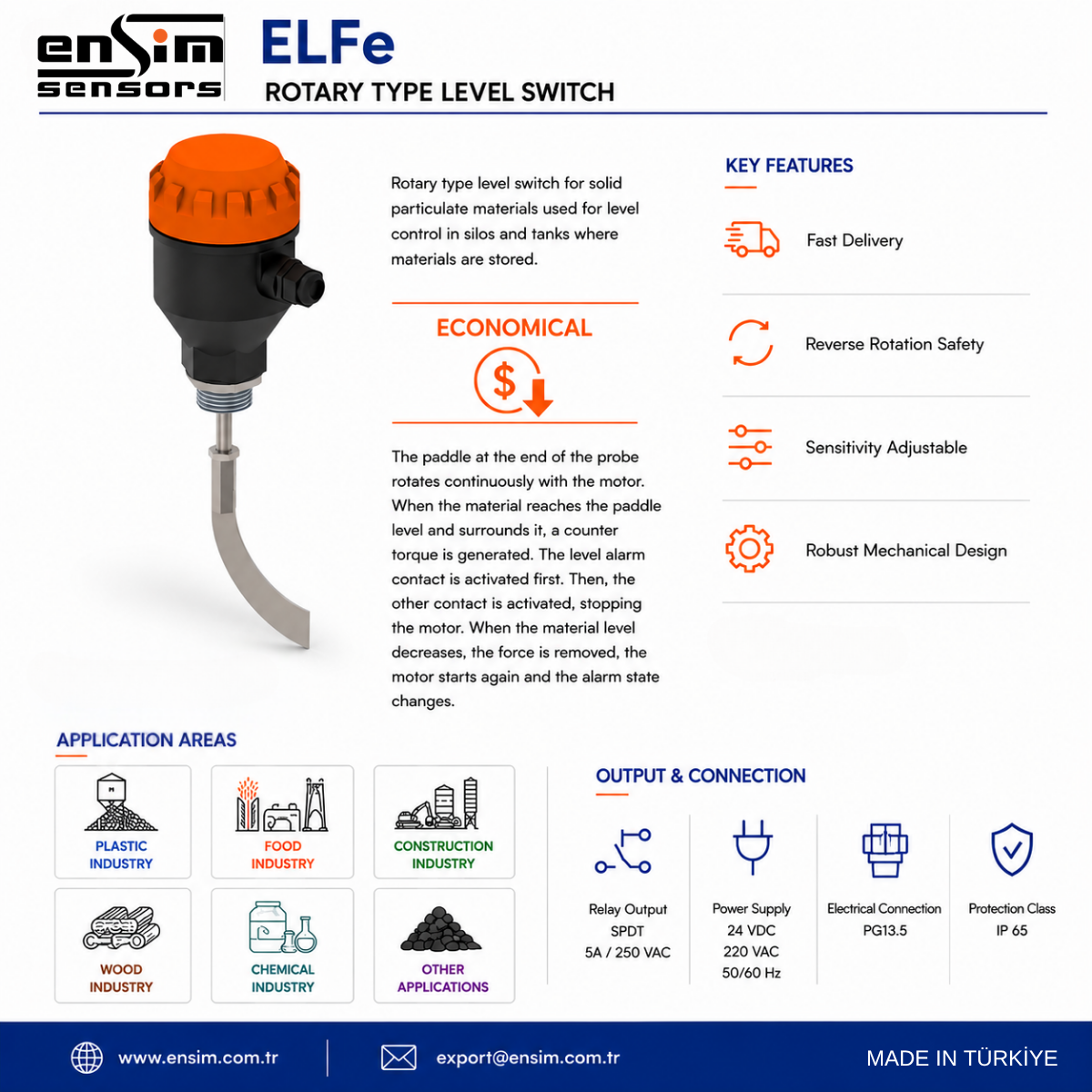
The ELFe 101 Rotary Type Level Switch is designed for level control in silos and tanks where solid particulate materials are stored. With its motor-driven paddle structure, adjustable torque mechanism and durable mechanical construction, ELFe 101 provides a practical and economical solution for point level detection in bulk solid applications.
What Is ELFe 101?
ELFe 101 is a motorized level switch used for detecting the presence or absence of solid particulate materials inside silos and tanks. It is designed as a rotary paddle type level switch.
The device is mounted on the tank wall. A paddle selected according to the application is located at the end of the probe. When the material reaches the paddle, the rotation is resisted and the switch generates a level signal.
This makes ELFe 101 suitable for high-level alarm, low-level alarm and general point level control applications in bulk solid storage systems.
Operating Principle
The ELFe 101 works with a motor-driven rotating paddle. When the area around the paddle is empty, the probe rotates continuously at the motor speed.
When the material level rises and covers the paddle, the material creates a counterforce against the rotation. First, the level alarm contact becomes active. Then a second contact stops the motor.
When the material level drops and the force on the paddle disappears, the motor starts rotating again and the alarm state changes.
This simple and reliable principle makes ELFe 101 a practical solution for silo and tank level control.
Adjustable Torque for Different Material Densities
One of the key advantages of ELFe 101 is the adjustable torque mechanism. The user can adjust the torque according to the specific gravity of the tested material.
When the material density is high, the torsion spring can be set to the strongest position. In this case, paddle sensitivity becomes lower, helping prevent false switching in heavy materials.
When the material density is low, the spring can be set to a weaker position. This improves paddle sensitivity and allows the switch to detect lighter materials more reliably.
The torque adjustment is made by opening the connection box, removing the torsion spring near the perforated end and placing it into the required hole. The hole near the terminal block provides the weakest torsion.
Application Areas
ELFe 101 can be used in a wide range of bulk solid applications. The catalog lists application areas in the plastics industry, food industry, construction industry, wood industry, chemical industry and other material handling processes.
In the plastics industry, it can be used for materials such as PVC, PVDF and PP granules.
In the food industry, typical materials include grain, flour, salt, powder sugar, coffee, barley, sunflower seeds, rice, fish feed, wheat, peanuts, chocolate and cocoa.
In the construction industry, ELFe 101 can be used with lime, sand, cement, silica sand, calcium powder, limestone powder, gypsum powder, crushed limestone and molding sand.
In the wood industry, typical applications include sawdust filters and wood fibers. In the chemical industry, it can be used for pharmaceutical raw materials. Other applications include coal dust and coal.
Technical Specifications
ELFe 101 has an ambient temperature range of -20 °C to +80 °C. Ambient humidity is 0–98% RH, non-condensing. The working pressure is atmospheric.
The connection material is 304 stainless steel, the housing material is aluminum, and the paddle and rod material are 304 stainless steel.
The standard mechanical connection is R 1" male thread. Power consumption is 4 W, and dielectric strength is AC1500V for 1 minute.
The measuring torque is 1.0 Nm, and the rotation speed is 1 rpm. The minimum material density is greater than 0.5 g/cm³.
Power Supply and Relay Output
ELFe 101 can be supplied with 24 VDC ±10% or 220 VAC 50/60 Hz ±10%.
The relay capacity is SPDT 5A / 250 VAC, allowing the switch to be used in alarm circuits, control panels, PLC inputs or motor control systems.
The cable and plug entry is PG13.5, and the electrical connection is terminal type.
Protection Class and Certification
The protection class of ELFe 101 is IP65 according to EN60529. This provides protection for standard industrial environments where dust and splashing may be present.
The certification is listed as CE declaration, supporting use in industrial applications that require basic product conformity.
Mechanical Design and Dimensions
The ELFe 101 has a compact rotary paddle design. The product drawing shows an R 1" threaded process connection and a curved paddle structure with defined rotation direction.
The label example identifies the product as a Rotary Type Level Switch and includes key information such as power supply, process connection, insertion length, blade paddle specification and serial number.
The standard rod and paddle configuration is designed for practical installation in silo and tank walls.
Ordering Configuration
The ordering structure allows users to define model, certificate, rod type, paddle type, connection, connection material, power supply, rotation speed, dust seal material, bearing type, housing material, electrical connection and optional accessories.
The standard paddle type is a 304 stainless steel sword paddle. The standard connection is R 1" male thread, and the standard connection material is 304 stainless steel.
The standard dust seal material is NBR, suitable up to 90 °C. The standard bearing is a metal ball bearing, suitable up to 120 °C. The housing material is aluminum.
An optional 304 stainless steel Manflon R 1 connection accessory is available.
Common Faults and Troubleshooting
The catalog provides useful troubleshooting guidance.
If the material reaches the paddle but the paddle continues rotating, the likely cause is a mismatch between material density and paddle size. The recommended solution is to resize the paddle.
If the paddle or drive shaft becomes deformed, excessive material impact may be the cause. In this case, suitable protective measures should be taken.
If the paddle does not rotate, possible causes include incorrect power connection or motor failure. The wiring should be checked first. If the motor is damaged, the manufacturer should be contacted for motor replacement.
Advantages of ELFe 101
ELFe 101 offers several practical advantages for industrial users. It has a fast delivery structure, reverse rotation safety, adjustable sensitivity and excellent mechanical strength.
Its rotary paddle principle is simple and easy to understand, making installation and commissioning straightforward. The adjustable torque system allows adaptation to different bulk solid densities.
Why Choose ELFe 101?
ELFe 101 is a strong choice for applications requiring reliable point level detection in bulk solid silos and tanks. Its motorized paddle design provides clear level indication when the material reaches the switching point.
With stainless steel wetted parts, aluminum housing, adjustable torque, SPDT relay output and IP65 protection, it provides a practical solution for plastics, food, construction, wood, chemical and coal-related applications.
For users looking for an economical and mechanically durable rotary level switch, ELFe 101 offers a balanced solution for bulk solid level control.
Conclusion
The ELFe 101 Rotary Type Level Switch is a reliable motorized level switch for solid particulate materials stored in silos and tanks. Its rotating paddle principle, adjustable torque mechanism, stainless steel paddle and rod, aluminum housing and SPDT relay output make it suitable for many industrial bulk solid applications.
From plastic granules and flour to cement, sand, wood fibers, pharmaceutical raw materials and coal, ELFe 101 helps operators monitor level conditions safely and improve process reliability.