
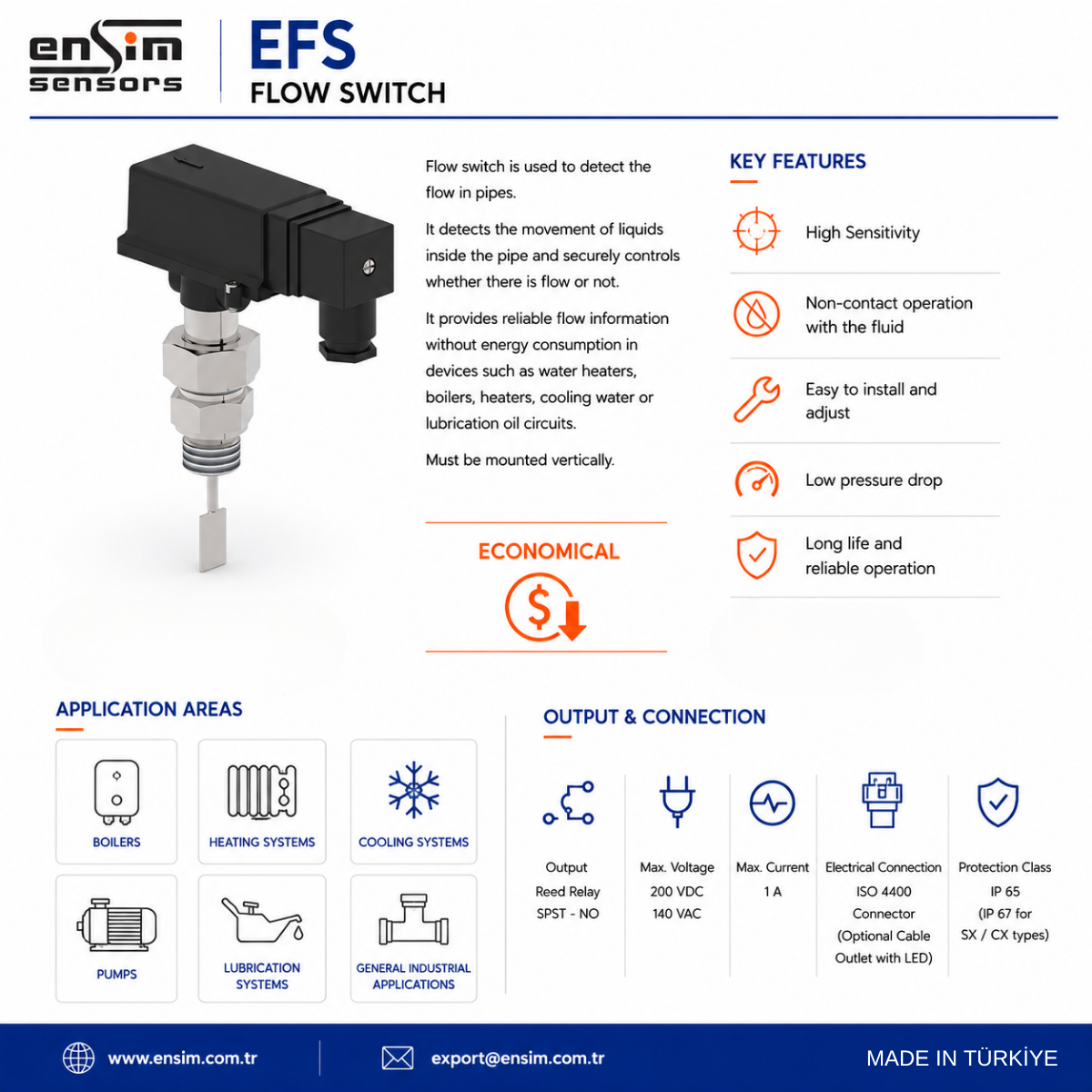
In industrial systems, knowing whether there is flow inside a pipeline is essential for equipment safety and process reliability. Cooling water circuits, lubrication lines, heating systems, boilers and similar installations require dependable flow detection to prevent overheating, dry running, equipment damage and process interruptions.
The EFS 05 Flow Switch Series is designed to check safely whether liquid flow is present inside a pipe. With its paddle-based operating principle, reed relay contact, low pressure drop and economical design, the EFS series provides a practical solution for flow/no-flow monitoring in industrial applications.
What Is the EFS 05 Flow Switch Series?
The EFS flow switch is used to detect the movement of liquids inside a pipe and provide reliable information about whether flow exists or has stopped.
The series includes many model options such as EFS 05s, EFS 05sx, EFS 05p, EFS 05px, EFS 06s, EFS 06sx, EFS 06p, EFS 06px, EFS 08s, EFS 10s, EFS 15s, EFS 20s, EFS 25s, EFS 32s, EFS 40s, EFS 50s, and related plastic, cable and special body versions.
This wide model range allows the product to be selected according to pipe size, connection type, material, pressure requirement and electrical connection preference.
Operating Principle
The EFS flow switch works with a paddle mounted inside the pipe flow path. The paddle is fixed from one point on the body and moves when the fluid flows through the pipe.
When there is flow, the paddle moves and activates the magnetic reed relay mechanism. When flow stops, the paddle returns to its original position with the help of reverse-pole magnets.
This magnetic return system provides longer service life and higher pressure resistance compared with spring mechanisms. Since the reed relay is not in contact with the fluid, the electrical switching circuit is separated from the process medium.
Factory Contact Logic and Adjustable Relay Position
As factory setting, the contact is closed when there is flow and opens when flow stops. The opposite switching behavior can be adjusted by the user by changing the relay position inside the housing.
This allows the flow switch to be configured as normally open or normally closed according to the control system requirement.
Designed for Vertical Installation
The catalog states that the EFS flow switch should be assembled vertically. Correct installation position is important for reliable paddle movement and accurate switching.
Proper mounting helps ensure that the paddle moves freely with the flow and returns correctly when flow stops.
Main Advantages
The EFS series offers several practical advantages. It provides high precision, easy adjustment and simple assembly. The relay circuit does not contact the fluid, which improves safety and reliability.
The switch also creates low pressure drop in the pipeline and offers an economical solution for flow monitoring applications.
Material Options
The EFS series is available in stainless steel and plastic types.
For stainless steel versions such as EFS ..s, the body, thread and nut are made of AISI 304 stainless steel, with AISI 316 stainless steel available as an option. The T-body is also AISI 304 stainless steel as standard, with AISI 316 stainless steel optional. The bolt and paddle are AISI 316 stainless steel.
For plastic versions such as EFS ..p, the body, thread, nut, bolt, paddle and T-body are made of polypropylene.
The relay case and magnet case are polypropylene in both versions. The O-ring is FPM for stainless steel versions and NBR for plastic versions.
Fluid Compatibility
The standard medium is water. The catalog states that oil, gas and aggressive media are available on request.
This makes the EFS series mainly suitable for water-based flow detection, while special applications should be evaluated according to material compatibility and operating conditions.
Pressure and Temperature Ratings
The maximum working pressure differs according to material type. Stainless steel versions have a maximum working pressure of 25 bar, while plastic versions have a maximum working pressure of 10 bar.
The working temperature range is -20 °C to +110 °C for stainless steel versions and -20 °C to +70 °C for plastic versions. Ambient temperature range is -20 °C to +70 °C for both types.
These ratings make stainless steel models suitable for more demanding industrial conditions, while plastic models provide an economical option for lower-pressure and lower-temperature applications.
Electrical Contact Specifications
The EFS series uses a reed switch SPST-NO contact as standard. Contact tolerance is ±15% of full-scale value.
The maximum contact current is 1 A, maximum contact power is 10 W / VA, and maximum switching voltage is 200 VDC / 140 VAC.
The catalog warns that voltage, current and power limits must not be exceeded. When switched on, a load must be connected in series. Electrical data apply to ohmic loads. Capacitive or inductive loads should be operated with a protective circuit.
Electrical Connection Options
The standard electrical connection is an ISO 4400 socket. Optional versions include cable output and socket with LED.
Protection class is IP65 as standard. IP67 versions are available for specific models, including sx, cx, px and bx type versions.
The ordering structure also includes terminal connection for housing models, polyamide big socket, polyamide big socket with light, M12 2-pin, M12 5-pin, PVC cable up to 60 °C and PVC cable up to 105 °C.
Reed Relay Protection for Inductive and Capacitive Loads
The catalog includes important operating recommendations for reed relay protection. When reed switches are used with inductive loads such as electromagnetic relays, contactors or solenoids, high voltage can occur depending on the inductive load value. This can damage the reed switch or shorten its service life.
For inductive loads, the catalog recommends protective solutions such as diode protection for DC circuits, RC protection for AC circuits or varistor protection.
For capacitive loads, high current may flow during charge and discharge. Protective circuits such as resistor and capacitor arrangements or neon lamp protection can be used depending on the voltage type.
Model Range for Different Pipe Sizes
The EFS series offers many model options according to pipe size and flow range.
Compact models such as EFS 05s / 06s and EFS 05p / 06p are designed for larger pipe sizes with 1/2" BSP connection and different paddle lengths.
Other stainless steel models cover pipe sizes from DN8 to DN50, including EFS 08s, 10s, 15s, 20s, 25s, 32s, 40s and 50s. Plastic models cover sizes such as EFS 15p, 20p, 25p, 32p, 40p and 50p.
Cable-output versions such as EFS 05sx, 06sx, 05px, 06px, 20cx, 25cx, 32cx, 40cx, 50cx, 20sx, 25sx, 32sx, 40sx and 50sx are available for applications where cable connection is preferred.
Flow Rate Examples
The catalog provides rising and falling flow rate values for water depending on model and pipe size.
For example, EFS 05s with DN50 pipe size has rising flow rate values of 1.5 / 2.5 m³/h and falling flow rate values of 1.4 / 2.2 m³/h. For DN100, the same model has rising flow rate values of 6 / 10.5 m³/h and falling flow rate values of 5.5 / 10 m³/h.
For smaller inline models, EFS 15s for DN15 has a maximum flow of 60 L/min, rising flow rate of 3.1 L/min and falling flow rate of 2.5 L/min. EFS 50s for DN50 has a maximum flow of 300 L/min, rising flow rate of 35 / 48 L/min and falling flow rate of 34 / 47 L/min.
These values help users select the correct model according to pipe size and required switching point.
Typical Application Areas
The EFS 05 flow switch series is suitable for cooling water circuits, lubricating oil circuits, flash heaters, central heating boilers and heater systems.
It can also be used in general industrial pipelines where reliable flow/no-flow detection is required without additional energy consumption at the measuring point.
Why Choose the EFS 05 Series?
The EFS 05 series is a strong choice for applications requiring an economical, easy-to-install and reliable flow switch.
Its paddle and magnet-based return mechanism provides dependable operation, while the reed relay offers precise switching. The separation of the relay circuit from the fluid improves reliability and makes the product practical for industrial service.
With stainless steel and plastic body options, multiple connection types, several pipe size configurations and different electrical connection choices, the EFS series can be adapted to many installation requirements.
Conclusion
The EFS 05 Flow Switch Series provides reliable liquid flow detection for industrial pipe systems. With its paddle-based working principle, magnetic return mechanism, reed relay output, low pressure drop and economical design, it is suitable for water flow monitoring in cooling, heating and lubrication circuits.
Thanks to its broad model range, stainless steel and polypropylene material options, IP65/IP67 protection alternatives and configurable contact structures, the EFS series offers a flexible and practical solution for safe flow/no-flow monitoring in industrial applications.