
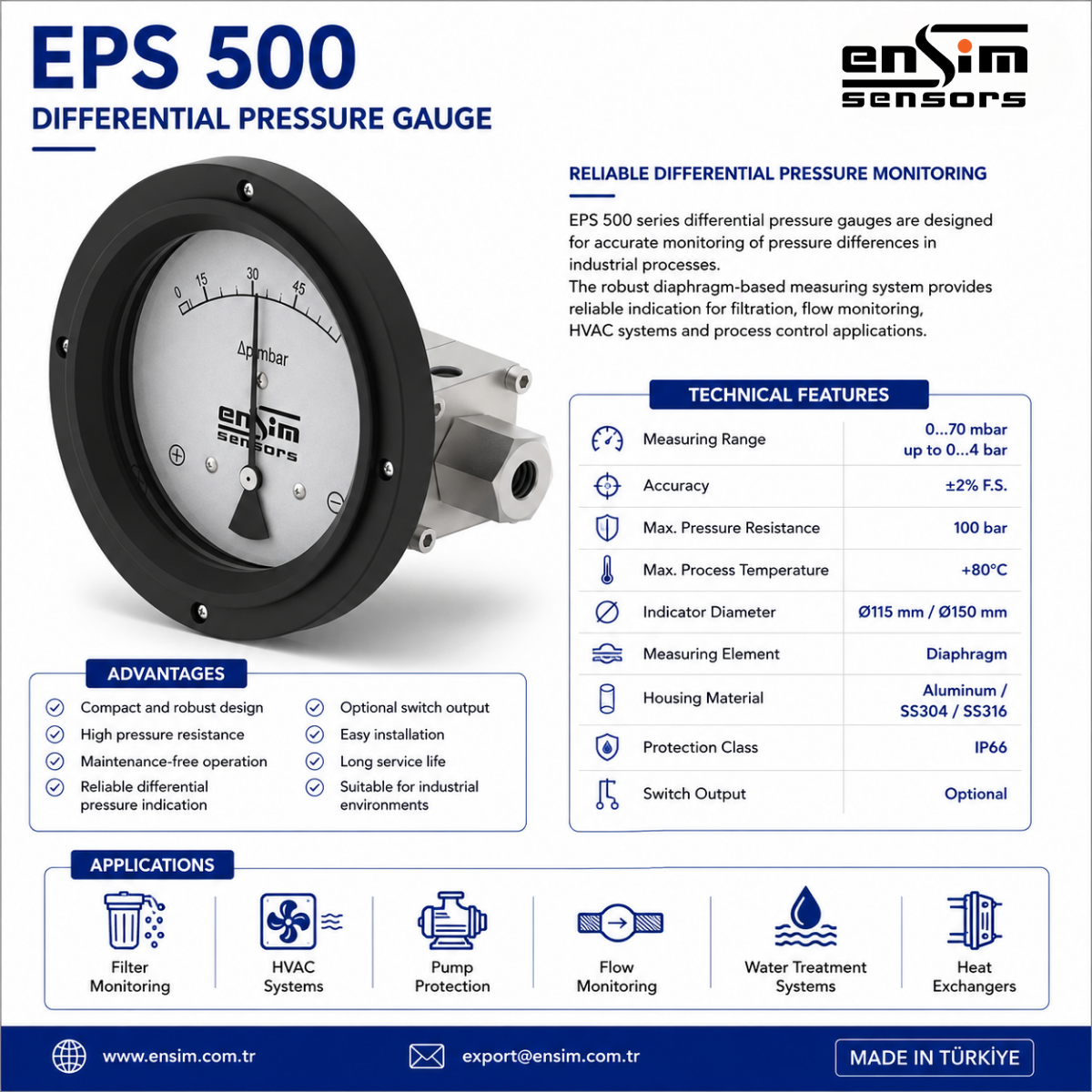
Differential pressure measurement is a critical parameter in many industrial systems. It helps operators monitor filter contamination, protect pumps and blowers, control flow, measure tank level and maintain process safety. In applications where two pressure points must be compared, a reliable differential pressure gauge provides clear visual information and, when required, an electrical contact signal for automation or alarm systems.
The EPS 500 Differential Pressure Gauge is designed for these demanding industrial requirements. With its compact structure, zero-leakage design, high-pressure resistance and customizable scale options, EPS 500 offers a practical solution for many different industries.
What Is EPS 500?
EPS 500 is a differential pressure gauge used to measure and display the pressure difference between two points in a system. It is suitable for applications where process safety, efficiency and equipment health must be monitored continuously.
The product family includes several model options: EPS 501 standard type, EPS 502 standard contact type, EPS 503 double-diaphragm type, EPS 504 double-diaphragm contact type, EPS 505 valve-adjusted contact type and EPS 506 valveless contact type.
This model variety allows users to select the correct configuration according to the application, installation style and control requirement.
Operating Principle
The working principle of EPS 500 is based on detecting the mechanical movement created by two different pressure values entering the instrument. The device has two separate ports: a high-pressure inlet marked H and a low-pressure inlet marked L.
These two pressure chambers are separated by a sensor mechanism consisting of a diaphragm, piston and calibrated measuring spring. The pressure difference between the high and low pressure sides causes the diaphragm and piston mechanism to move proportionally. This linear movement is then converted into rotary movement for the indicator needle.
One of the key design advantages of EPS 500 is that the internal mechanism measuring the differential pressure is completely isolated from the indicator section. The movement is transferred to the pointer by magnetic coupling. This prevents fluid migration from the high-pressure side to the low-pressure side and supports safe, reliable operation.
Contact Output for Alarm and Control
Contact models of the EPS 500 series can generate an electrical switching signal at a preset differential pressure value. When the pressure difference reaches the adjusted set point, the piston movement activates a reed relay mechanism.
When the pressure difference falls below the adjusted value, the spring returns the mechanism to its original position and the contact resets. This makes contact models suitable for alarms, filter cleaning signals, pump protection, automation inputs and system safety functions.
The contact structure is SPDT – 1 x NO/NC, with 1 A contact current, 200 VDC / 140 VAC maximum supply voltage and 10 W / VA maximum contact power.
Technical Specifications
EPS 500 offers a differential pressure measuring range from 0–70 mbar up to 4 bar. The measuring element is a diaphragm, with a double-diaphragm option available depending on the model.
The gauge is available with Ø115 mm and Ø150 mm display diameters. Accuracy is specified as ±2% of full scale. The device has a maximum pressure resistance of 100 bar and a maximum operating temperature range of -20 °C to +80 °C.
The standard body material is aluminum, with optional 304 or 316 stainless steel. The standard diaphragm material is neoprene rubber, with Viton available as an option. The standard fitting material is 304 stainless steel, with optional 316 stainless steel. The gauge glass is soda glass as standard, with safety glass available as an option.
The electrical connection is an ISO 4400 socket, with an optional illuminated socket. The protection class is IP66 according to EN60529, and the product weight varies from approximately 840 g to 1500 g, depending on the model.
Key Advantages
The EPS 500 series provides several important advantages for industrial users. Its compact structure allows installation in limited spaces, while the zero-leakage design helps prevent fluid transfer between high and low pressure sides.
The device is resistant to high pressure and can be supplied with customized scale options. Different scale versions can be selected for differential pressure, level, flow or special customer requirements. Optional mounting brackets also make installation easier in different field conditions.
Mounting Options
EPS 500 can be installed in different ways depending on the application and site conditions. The catalog shows surface mounting, vertical pipe mounting and horizontal pipe mounting options.
These mounting alternatives make the device suitable for filter skids, pipelines, machinery systems, HVAC units, water treatment systems, marine applications and industrial process equipment.
Filter Contamination and Condition Monitoring
One of the most common applications of EPS 500 is filter monitoring. As a filter becomes contaminated, the pressure drop across the filter increases. By measuring this differential pressure, EPS 500 helps operators understand when cleaning or replacement is required.
In air filtration systems, the device can be used in hospitals, pharmaceutical facilities, semiconductor production, laminar flow benches, fluidized bed dryers and distribution cabinets. In these applications, monitoring filter performance is essential for maintaining high-quality air conditions.
In irrigation filtration systems, EPS 500 can detect clogged filters and send a signal for automatic backflush operation. This helps prevent unfiltered water from reaching the field.
In natural gas filtration, the device can monitor filter condition in applications where high levels of dirt particles may be present. In ballast water filtration, it can start an automatic cleaning cycle when the preset differential pressure is reached.
Flow Monitoring and Control
EPS 500 can also be used for flow monitoring and control. By measuring the pressure difference across valves or flow elements in a pipeline, the device helps operators adjust and monitor flow rate.
For pulsating flow conditions, glycerin-filled gauge models can be preferred. This helps stabilize the indication and improve readability in applications where vibration or pressure fluctuation is present.
The device can also be used for backflow prevention systems, where differential pressure testing is required to verify the installation and operation of backflow prevention equipment.
Level Measurement Applications
Differential pressure can be used as a reliable method for tank level measurement. In open or pressurized tanks, the liquid level can be represented visually according to the pressure head created by the liquid column.
For open tanks, the high-pressure port is connected to the bottom of the tank and the low-pressure port is open to atmosphere. For closed tanks, the high-pressure port is connected to the bottom and the low-pressure port is connected to the top of the tank. This configuration enables accurate level indication.
EPS 500 can also be used in cryogenic tank level measurement for gases such as liquid oxygen, liquid nitrogen and carbon dioxide. In these applications, dry-type gauges and oxygen-cleaned designs may be used where required.
Pump, Blower and HVAC Monitoring
Pressure difference changes can indicate pump failure, pipeline blockage, blower performance problems or abnormal HVAC conditions. With switch-equipped EPS 500 models, operators can receive warning signals when high or low differential pressure conditions occur.
In heat exchanger applications, especially transformer oil cooling systems, EPS 500 can monitor pressure difference to help prevent water and oil from mixing. It can also detect increasing pressure drop caused by scaling or fouling in heat exchangers.
Model Options
The EPS 500 family includes different model configurations for different application needs.
EPS 501 is the standard type for visual differential pressure indication. EPS 502 adds contact output to the standard type. EPS 503 is the double-diaphragm type, while EPS 504 combines double-diaphragm structure with contact output. EPS 505 is a valve-adjusted contact type, and EPS 506 is a valveless contact type.
This range allows users to select a simple indication model or a contact-equipped model for alarm and automation integration.
Configuration Flexibility
EPS 500 can be configured according to the required body material, diaphragm material, gauge diameter, measuring range, scale type, pressure connection and optional accessories.
Available measuring ranges include 0–70 mbar, 0–100 mbar, 0–160 mbar, 0–200 mbar, 0–300 mbar, 0–400 mbar, 0–750 mbar, 0–1.1 bar, 0–1.5 bar, 0–2 bar, 0–3 bar and 0–4 bar.
Optional features include double scale, customer logo, illuminated socket, vertical pipe mounting bracket, horizontal pipe mounting bracket and surface mounting bracket.
Conclusion
The EPS 500 Differential Pressure Gauge is a versatile and reliable solution for industrial differential pressure measurement. With its compact design, magnetic coupling, zero-leakage structure, contact output options, high-pressure resistance and customizable scales, it is suitable for a wide range of applications.
From filter monitoring and flow control to tank level measurement, pump protection, blower monitoring, HVAC systems and heat exchanger safety, EPS 500 provides clear visual indication and practical control integration for modern industrial processes.