
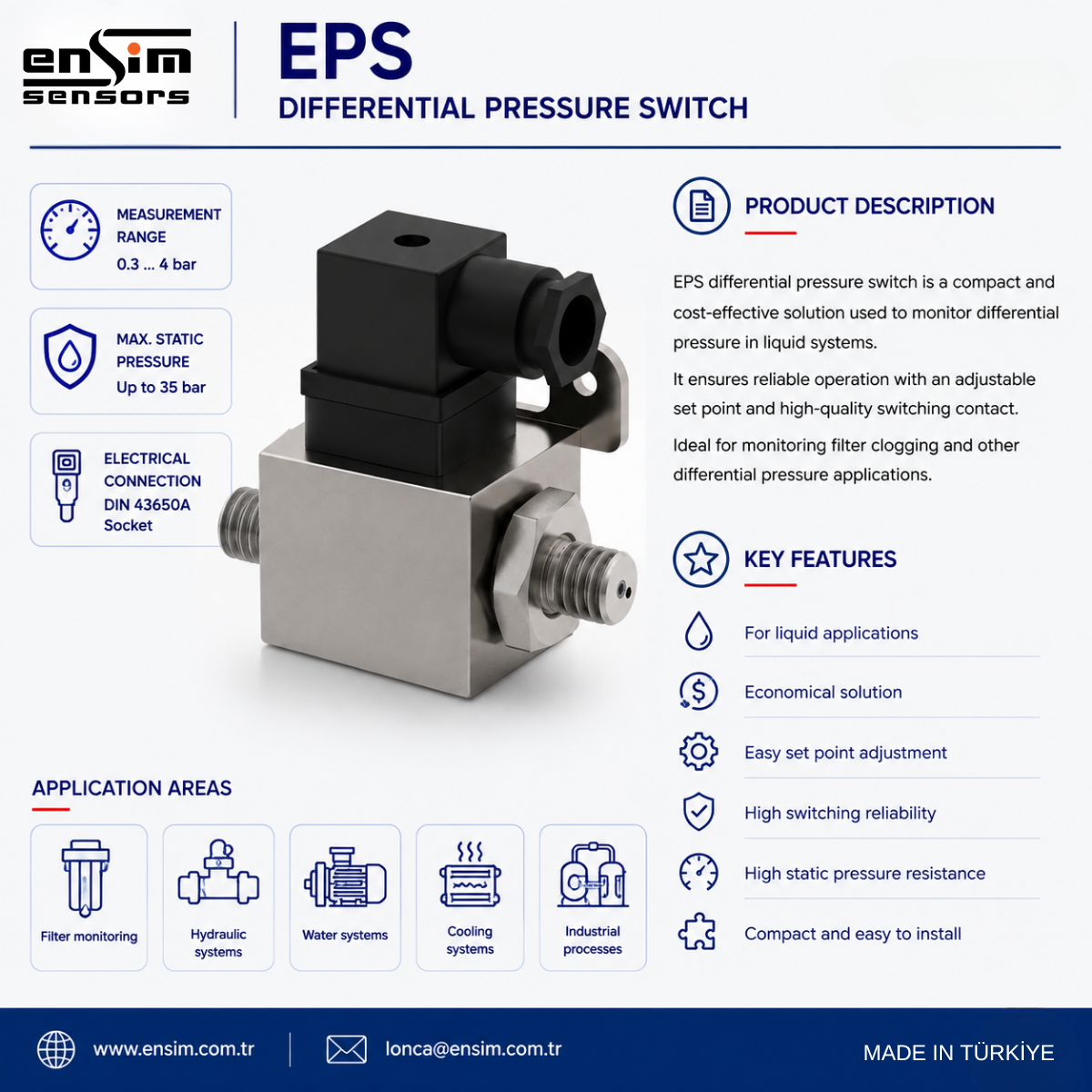
In industrial liquid systems, monitoring differential pressure is essential for safe and efficient operation. Filters, pumps, hydraulic circuits and process lines can be affected by pressure changes caused by contamination, blockage or flow restriction. When a filter becomes dirty or clogged, the pressure difference between the inlet and outlet sides increases. Detecting this change at the right time helps prevent equipment damage, process instability and unnecessary maintenance costs.
The EPS 200 Differential Pressure Switch is designed for this purpose. With its compact design, simple contact adjustment and economical structure, EPS 200 provides a practical solution for differential pressure monitoring in liquid applications.
What Is EPS 200?
EPS 200 is a differential pressure switch used to measure pressure difference in liquid systems and provide an electrical contact output.
The device is especially suitable for detecting filter contamination. By monitoring the pressure difference between both sides of a filter, EPS 200 helps identify when the filter is becoming clogged. If the differential pressure increases above the set value, the switch changes contact position and provides an alarm or control signal.
This makes EPS 200 useful for maintenance planning, filter protection and process monitoring.
Operating Principle
The EPS differential pressure switch uses a spring, piston and diaphragm design.
Inside the body, the diaphragm moves according to the differential pressure applied to the switch. This movement acts against the spring and changes the position of the adjusted microswitch.
When the pressure reaches the set value, the microswitch is triggered and a contact output is obtained. When the pressure falls below the adjusted level, the contact returns to its previous position.
This simple mechanical principle provides reliable switching and long service life.
Designed for Liquid Applications
EPS 200 is developed for liquid fluid applications. It is compact, easy to apply and economical.
In filter monitoring applications, the high-pressure side and low-pressure side are connected to both sides of the filter. As the filter becomes dirty, the pressure difference increases. EPS 200 detects this increase and switches the contact at the adjusted set point.
This allows the user to understand that the filter requires cleaning or replacement before the system performance is affected.
Technical Specifications
EPS 200 has a differential pressure measuring range of 0.3 to 3 bar.
The device has no local indicator. Repeatability is specified as ±2% at 20 °C.
The average dead band is listed as 0.2–0.4 bar and 0.35–1 bar, depending on the set range.
The maximum pressure resistance is 35 bar, making EPS 200 suitable for demanding liquid systems where pressure peaks may occur.
Electrical Output and Connection
EPS 200 provides 1 NO/NC contact output, rated at 3 A / 250 VAC.
The electrical connection is made through a DIN43650A socket. The catalog shows the socket terminal arrangement as:
1: Normally Open
2: Normally Closed
3: Common
This simple contact structure allows EPS 200 to be connected to alarm panels, PLC inputs, control relays, pump protection circuits or filter monitoring systems.
Mechanical Connection
The standard mechanical connection of EPS 200 is R 1/4".
The product dimensions are listed as approximately 95 mm length and 72.5 mm height. Its compact structure makes it easy to install in limited spaces, especially around filter housings or hydraulic blocks.
The device weight is approximately 0.5 kg.
Material Structure
EPS 200 has an aluminum body.
The diaphragm material is Buna-N, with Viton available as an option. The connection fittings are steel, with stainless steel available as an option. The spring is made of stainless steel.
These material options allow the product to be adapted according to liquid compatibility and application requirements.
Temperature and Protection Class
The standard working temperature range of EPS 200 is -20 °C to +80 °C.
An optional version is available for -40 °C to +120 °C operating temperature range.
The protection class is IP65, supporting use in industrial environments where dust and water splash protection are required.
Contact Adjustment
EPS 200 can be manufactured according to the required set values, and it can also be adjusted by the user.
For adjustment, the high-pressure inlet is connected to the pressure source. The set range is adjusted from the low-pressure side by turning the internal adjustment element.
Turning clockwise increases the set range, while turning counterclockwise decreases the set range. After adjustment is completed, both sides should be correctly connected to the system.
The catalog also notes that contact position can be checked from terminal 1 and terminal 3.
Installation Considerations
Correct installation is important for accurate differential pressure monitoring.
The high-pressure and low-pressure ports must be connected to the correct sides of the process. In filter applications, the high-pressure side is usually connected before the filter and the low-pressure side after the filter.
The catalog also shows installation warnings to prevent incorrect mounting orientation or unsuitable mechanical stress during installation.
Advantages of EPS 200
EPS 200 offers several important advantages for industrial users.
It is suitable for liquid fluids, economical and simple to adjust. Its compact structure allows easy installation in filter systems and process lines.
The mechanical spring-piston-diaphragm design provides direct and reliable switching without requiring complex electronics.
Application Areas
EPS 200 is especially suitable for filter contamination monitoring in liquid systems.
Typical applications include hydraulic systems, cooling circuits, lubrication systems, process liquid lines, filtration units, pump systems and industrial machinery.
In these applications, EPS 200 helps detect increasing differential pressure and provides a contact signal for alarm, maintenance or control purposes.
EPS 200 and EPS 201 Difference
The EPS series includes EPS 200 and EPS 201 models.
EPS 200 has a 0.3–3 bar range, aluminum body, R 1/4" mechanical connection and no indicator.
EPS 201 has a 0.5–4 bar range, stainless steel body, 8 mm hose connection and includes an indicator.
For applications requiring compact aluminum construction and threaded connection, EPS 200 is the appropriate model. For applications requiring local indication and hose connection, EPS 201 may be considered.
Why Choose EPS 200?
EPS 200 is a strong choice when a simple, economical and reliable differential pressure switch is required for liquid applications.
Its 0.3–3 bar measurement range, 35 bar pressure resistance, IP65 protection, adjustable contact point and standard DIN43650A electrical connection make it practical for many industrial systems.
For filter clogging detection and liquid differential pressure monitoring, EPS 200 provides a compact and dependable solution.
Conclusion
The EPS 200 Differential Pressure Switch is a compact and economical solution for monitoring differential pressure in liquid systems. With its spring, piston and diaphragm operating principle, it provides reliable NO/NC contact output when the pressure difference reaches the adjusted set point.
With 0.3–3 bar measuring range, 35 bar maximum pressure resistance, 3 A / 250 VAC contact rating, R 1/4" mechanical connection, aluminum body, Buna-N diaphragm and IP65 protection, EPS 200 is especially suitable for filter contamination detection and general liquid differential pressure monitoring applications.