
Reliable level control is essential in industrial machinery, hydraulic oil tanks, small storage tanks, and compact process systems. In many applications, the level switch must be economical, easy to install, compact in size, and suitable for different liquid media.
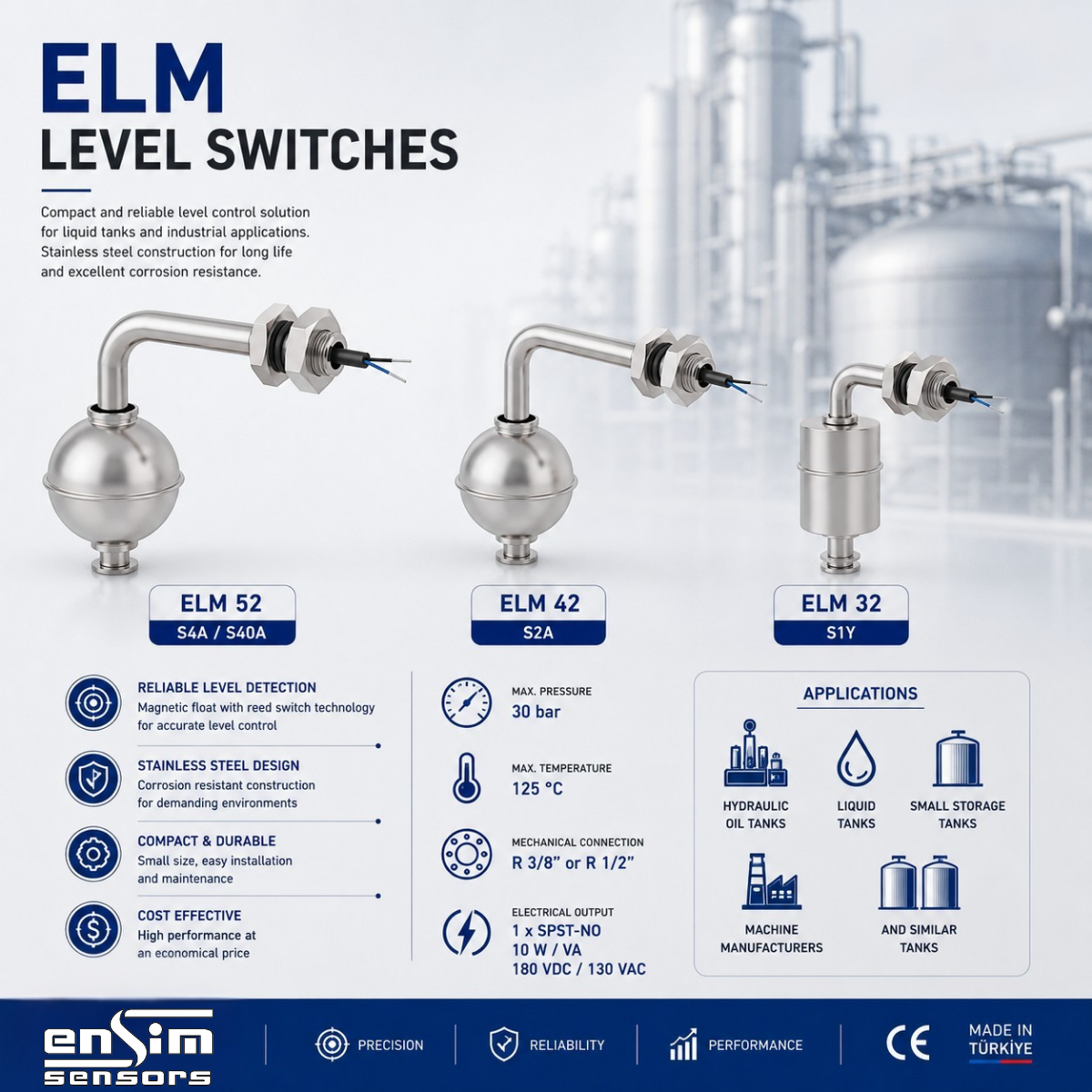
The ELM 32, ELM 42 and ELM 52 level switches are designed for these requirements. As part of the ELM magnetic float level switch series, these models offer practical and dependable level detection with stainless steel wetted parts, reed switch technology, and vertical mounting design.
What Are ELM 32, ELM 42 and ELM 52?
ELM 32, ELM 42 and ELM 52 are vertical type level switches used for tank level control. They are especially suitable for machinery manufacturers, hydraulic oil tanks, small reservoir applications, and similar compact tank systems.
Their small dimensions help save installation space, while their stainless steel body structure allows safe use with various liquids. These models are preferred where simple, robust, and cost-effective level control is required.
Operating Principle
The ELM series operates with a magnetic float and reed sensor principle. A magnet located inside the float moves according to the liquid level. When the magnetic field of the float reaches the reed sensor inside the tube, the electrical circuit opens or closes.
When the float moves away from the sensor position, the reed contact returns to its original state. This switching signal can be used directly or evaluated through a relay circuit to control pumps, alarms, valves, or automation systems.
On request, the contact structure can also be produced as a normally closed configuration depending on the application requirement.
Vertical Mounting Design
ELM 32, ELM 42 and ELM 52 are designed for vertical mounting. This makes them suitable for top-mounted or bottom-mounted tank level control applications, depending on the tank design and required switching point.
The vertical design is practical for compact tanks where horizontal installation is not preferred or where the available mounting area is limited. These models are especially useful for monitoring minimum or maximum liquid levels in small tanks and machinery systems.
Model Differences
The ELM 32 model uses an S1Y float type and is suitable for compact installations with smaller float dimensions. It has a maximum pressure rating of 10 bar and is designed for applications where a compact, economical level switch is required.
The ELM 42 model uses an S2A float type and has a larger spherical float design. It offers a maximum pressure rating of 30 bar and provides higher contact capacity compared to ELM 32.
The ELM 52 model uses S4A / S40A float options and is designed with a larger float structure. Like ELM 42, it has a maximum pressure rating of 30 bar and is suitable for applications requiring a more robust float design and larger connection size.
Technical Features
All three models are designed with stainless steel wetted parts. The wetted parts and tube material are 304 stainless steel as standard, with 316 stainless steel available as an option. This provides compatibility with various industrial liquids and supports long service life.
The maximum operating temperature for ELM 32, ELM 42 and ELM 52 is 125 °C. The minimum liquid density is 0.80 g/cm³ for all three models.
The electrical connection is made by cable. Each model has one standard float and one contact output. The contact structure is 1 x SPST-NO.
Electrical Ratings
ELM 32 has a contact current rating of 1 A, maximum contact power of 10 W / VA, and maximum supply voltage of 200 VDC / 140 VAC.
ELM 42 and ELM 52 have higher electrical switching capacity. Both models offer 1.5 A contact current, maximum contact power of 50 W / VA, and maximum supply voltage of 200 VDC / 250 VAC.
This allows the correct model to be selected according to the required electrical load and control system design.
Mechanical Connection Options
ELM 32 and ELM 42 are available with R 1/8" or M10x1 mechanical connection options. These smaller connection sizes make them suitable for compact machinery and small tank applications.
ELM 52 is available with R 3/8" or R 1/2" mechanical connection options, making it suitable for applications that require a larger and more robust installation structure.
Advantages of ELM 32, ELM 42 and ELM 52
The main advantages of these models are their compact structure, economical design, easy installation, and stainless steel construction. They are practical solutions for machine manufacturers and system integrators who need fast, reliable, and cost-effective tank level control.
Because they operate with magnetic reed switch technology, they provide simple and dependable on/off level detection. Their compact dimensions make them suitable for tanks where installation space is limited.
Optional Level Control Relay
The ELM 32, ELM 42 and ELM 52 models can be used with the optional SK-P2 liquid level relay. This allows the contact signal from the level switch to be integrated into control panels for pump start-stop, alarm, filling, or emptying applications.
Using a relay circuit can improve control flexibility and help adapt the switch output to the requirements of the automation system.
Typical Application Areas
These models are suitable for industrial machinery, hydraulic oil tanks, small storage tanks, compact reservoirs, auxiliary tanks, and similar liquid level control applications.
They are particularly useful in OEM machine manufacturing, where compact size, easy mounting, economical design, and quick delivery are important selection criteria.
Conclusion
ELM 32, ELM 42 and ELM 52 level switches provide compact, economical, and reliable solutions for vertical tank level control. With stainless steel wetted parts, reed sensor technology, simple cable connection, and optional SK-P2 relay compatibility, they are suitable for a wide range of small tank and machine applications.
ELM 32 is ideal for compact and lower-pressure applications, while ELM 42 and ELM 52 offer higher pressure ratings and stronger electrical switching capacity. Together, these models provide flexible options for practical and dependable liquid level control in industrial systems.