
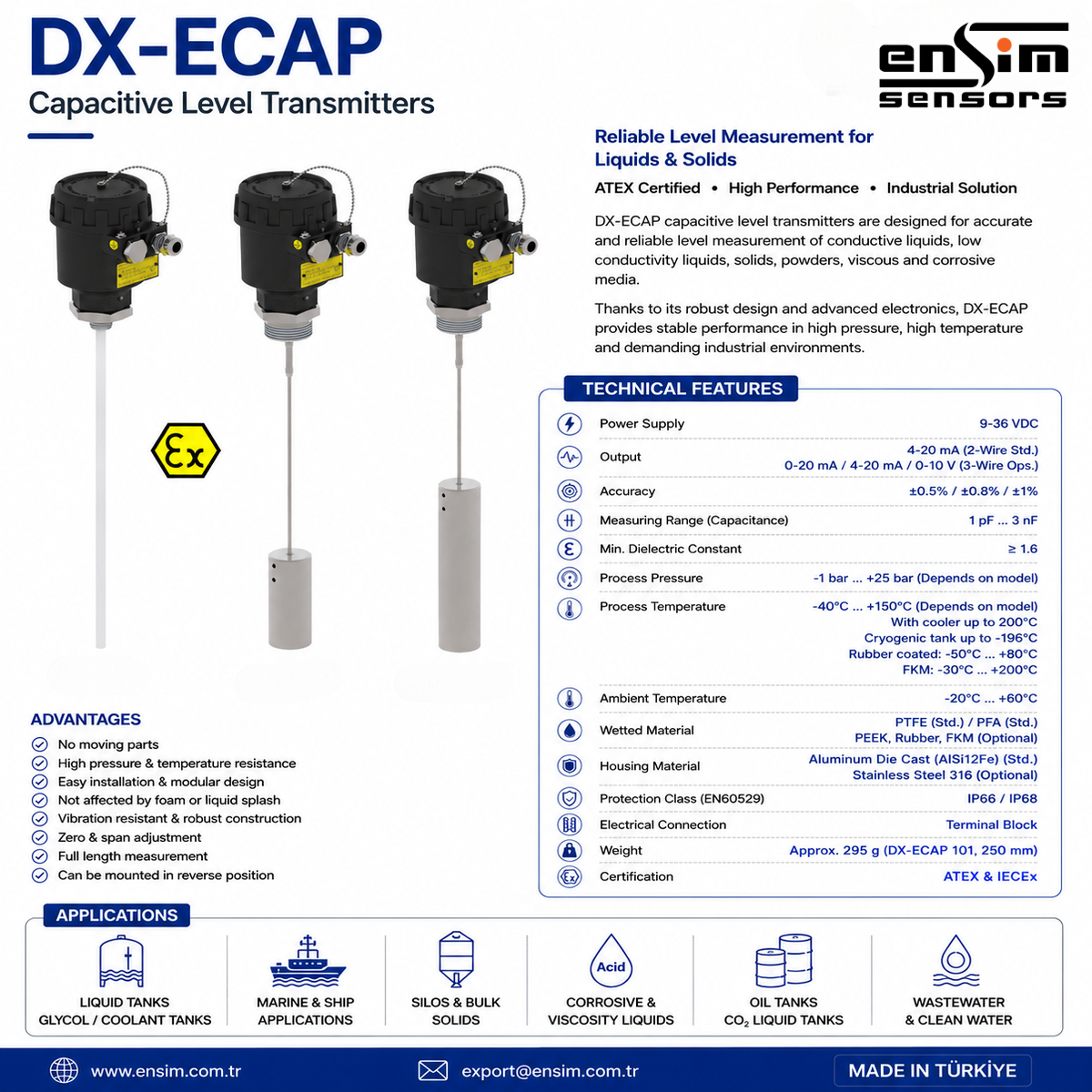
In industrial processes, accurate and stable level measurement is essential for operational safety, process continuity and efficient automation. Tanks, silos, storage vessels and process equipment often contain different types of materials, from conductive liquids and low-conductivity fluids to powders, granules, sticky liquids and aggressive chemical media.
The DX-ECAP Capacitive Level Transmitter is designed to provide reliable continuous level measurement across these demanding applications. With its capacitive measuring principle, modular construction, wide model range and robust mechanical design, DX-ECAP offers flexible solutions for industrial level measurement in liquids, bulk solids and chemical processes.
What Is DX-ECAP?
DX-ECAP is a capacitive level transmitter used for measuring level in conductive liquids, low-conductivity liquids, solid particulate materials, powders, sticky media and acidic or alkaline liquids.
The transmitter detects the capacitance change created between the electrode rod and the tank wall when material enters the measuring area. This capacitance change is measured precisely and converted into an analog output signal for process control, monitoring and automation systems.
The product family includes several model groups, such as DX-ECAP 101 / 102 / 103 / 107, DX-ECAP 202 / 203 / 204 / 205 / 20S, DX-ECAP 304 / 305 and DX-ECAP 408A / 408B. Each model group is designed for different process materials and installation conditions.
Operating Principle
The DX-ECAP works according to the capacitive measurement principle. In a simplified explanation, the probe and tank wall act as two conductive surfaces. When the material level changes around the probe, the dielectric properties between these surfaces change. This creates a measurable variation in capacitance.
In practical industrial applications, the device evaluates the electrical behavior of the medium using an advanced impedance-based approach. DX-ECAP sensors use a charge transfer method to detect level changes accurately and convert the measurement into a stable analog signal.
This measuring method enables continuous level measurement along the sensor length and allows the device to be used in many different tank geometries.
Easy Zero and Span Calibration
One of the practical advantages of DX-ECAP is its easy calibration. The zero adjustment defines the lower measuring point, typically corresponding to the 4 mA output. The span adjustment defines the upper measuring point, typically corresponding to the 20 mA output.
The measuring range and zero point can be shifted along the probe. This allows users to adapt the output signal to the required measurement zone inside the tank.
DX-ECAP can also operate in reverse mounting applications, providing additional flexibility for different installation requirements.
Wide Application Range
DX-ECAP is suitable for many industries and process applications. It can be used in liquid tanks, glycol tanks, food machinery, cooling liquid tanks, marine applications, brine tanks, wastewater systems, wine tanks and clean water tanks.
It is also suitable for oil tanks, liquid CO₂ tanks, high-temperature tanks and low-conductivity liquid applications.
For bulk solid applications, DX-ECAP can be used in grain silos, cement silos, sand tanks, dough, milk powder, feed, flour, organic material and plastic granule tanks.
Special model options are available for hot adhesives, high-viscosity acidic liquids, alkaline liquids and chemical fluids.
Key Advantages
DX-ECAP has no moving parts. This reduces mechanical wear and helps minimize maintenance requirements in industrial environments.
Its robust mechanical structure makes it resistant to vibration, while the measuring principle is not affected by foam or liquid splashing. This is especially important in process tanks, mixing vessels and applications where the material surface is unstable.
The transmitter has a modular structure, making installation and configuration easier for machine manufacturers, system integrators and process users. It also offers continuous measurement along the complete sensor length.
Technical Specifications
DX-ECAP operates with a 9–36 VDC power supply. The standard output is 4–20 mA two-wire, while optional outputs include 0–20 mA, 4–20 mA three-wire and 0–10 V three-wire configurations.
The operating pressure range is -1 bar to +25 bar, depending on the model. The standard operating temperature range is -40 °C to +150 °C. With a cooling adapter, the device can be used up to 200 °C. Special versions are available for cryogenic tanks down to -196 °C.
For rubber-coated versions, the temperature range is -50 °C to +80 °C. For FKM versions, the temperature range is -30 °C to +200 °C.
The ambient temperature range is -20 °C to +60 °C. The protection class is IP66 / IP68 according to EN60529.
Materials and Construction
The standard insulation material is PFA. Optional insulation materials include PEEK, PTFE, rubber and FKM, allowing the device to be selected according to the process medium and temperature conditions.
The standard connection material is 304 stainless steel, with 316 stainless steel available as an option. The standard housing is aluminum injection AlSi12Fe, black RAL 9005.
The housing design includes power and adjustment LEDs, supporting practical field operation and commissioning.
Measurement Performance
DX-ECAP offers a capacitance measuring range of 1 pF to 3 nF. The minimum dielectric constant is εr 1.6, making the transmitter suitable for low-conductivity liquid applications.
Accuracy options include ±0.5%, ±0.8% and ±1%, depending on configuration and application. Linearity is specified as 0.5%. The device has a maximum power consumption of 50 mW and insulation up to 500 V.
The maximum allowable force on the probe is 40 Nm, supporting robust use in demanding industrial applications.
Model Options for Conductive Liquids
For conductive liquids, DX-ECAP offers models such as DX-ECAP 101, 102, 103 and 107.
DX-ECAP 101 is designed with a fully insulated probe for conductive tanks. DX-ECAP 102 and 103 offer coaxial probe structures for conductive or non-conductive tanks. DX-ECAP 107 provides insulated rope probe options for longer measurement ranges.
These models are suitable for water-based liquids, process fluids and conductive tank applications where stable capacitive measurement is required.
Model Options for Low-Conductivity Liquids
For low-conductivity liquids, models such as DX-ECAP 202, 203, 204, 205 and 20S are available.
These versions include non-insulated coaxial probes, non-insulated probes and rope probe options. They are suitable for liquids where the dielectric properties require a specific probe configuration for reliable measurement.
DX-ECAP 20S is designed for high-temperature applications and can operate up to 400 °C according to the model structure shown in the catalog.
Solutions for Solid Particulate Materials
For solid particulate materials, DX-ECAP 304 and DX-ECAP 305 provide suitable configurations.
These models are designed for applications such as grain, cement, flour, feed, plastic granules and other bulk solid materials. The available probe and rope designs allow the transmitter to be adapted to different silo heights and material characteristics.
Solutions for Sticky and Acidic or Alkaline Liquids
For sticky materials and acidic or alkaline liquids, DX-ECAP 408A and DX-ECAP 408B are available.
These versions are designed for challenging chemical applications where coating, viscosity or chemical aggressiveness may affect standard level measurement methods. The correct insulation and material selection helps ensure reliable operation in these demanding process conditions.
Electrical Connection and Output Configuration
DX-ECAP supports several electrical output configurations. The available signal options include 4–20 mA two-wire, 4–20 mA three-wire, 0–20 mA three-wire and 0–10 V three-wire.
The catalog also describes switch settings for output signal selection and calibration. Configuration is determined when power is applied, so output selection must be made correctly before energizing the device.
This flexibility allows DX-ECAP to be integrated into PLC systems, analog input modules, indicators, recorders and industrial automation systems.
Mechanical Connection Flexibility
DX-ECAP can be supplied with many mechanical connection types. Threaded options include R 1/2, R 3/4, R 1, R 1 1/2, R 2, as well as 1/2 NPT and 3/4 NPT.
Flanged options include DN25, DN32, DN50, DN80 and DN100 according to ISO standards, as well as ANSI 150 lbs flange options. Clamp and dairy connection options are also available.
This wide connection range makes DX-ECAP suitable for process tanks, food machinery, chemical vessels, silos and OEM equipment.
ATEX-Certified Versions
DX-ECAP is available with ATEX certification for explosive gas and dust atmospheres. This makes the device suitable for hazardous area applications when the correct certified configuration is selected.
The catalog also includes temperature class information for standard and cooled versions, supporting safe product selection in explosive atmosphere applications.
Why Choose DX-ECAP?
DX-ECAP is a strong choice for users who need a flexible, durable and maintenance-friendly level measurement solution.
Its no-moving-part design, resistance to foam and splashing, vibration-resistant mechanical structure, easy zero-span calibration and wide range of probe configurations make it suitable for many different industries.
For machine manufacturers, DX-ECAP provides compact and adaptable designs. For process plants, it offers reliable continuous level measurement in liquids, powders, granules, sticky materials and chemical media.
Conclusion
The DX-ECAP Capacitive Level Transmitter is a versatile solution for continuous level measurement in industrial applications. With its capacitive measurement principle, analog output options, modular probe designs, wide material compatibility and robust construction, it provides reliable performance in conductive liquids, low-conductivity liquids, bulk solids and aggressive process media.
From food and chemical processes to wastewater, marine, oil, CO₂ tanks, cement silos and plastic granule storage, DX-ECAP helps operators monitor level accurately and improve process safety, automation efficiency and operational reliability.